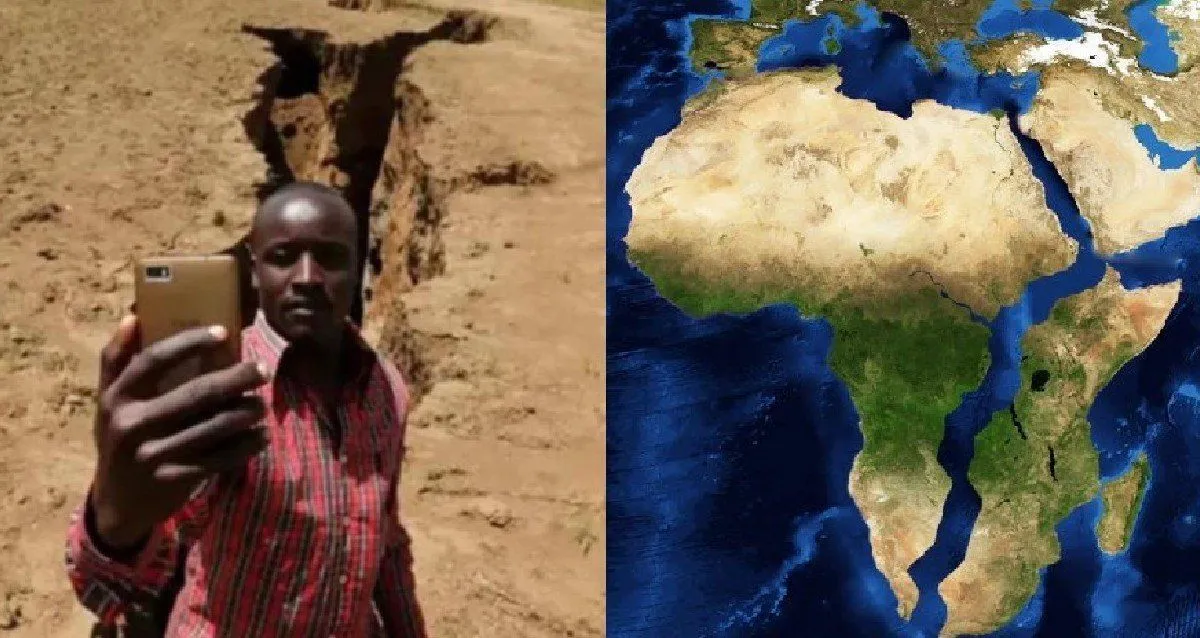
“Africa is splitting apart faster than we thought, forming a new ocean,” stated a lead researcher, highlighting the urgency of recent findings regarding the East African Rift System. This geological marvel, located in East Africa, is witnessing the rapid separation of the Nubian Plate and the Somali Plate, a process that could reshape the continent over millions of years.
The East African Rift System has reached what scientists call a “critical threshold.” This means that the geological processes at play are now more intense than previously understood. The Turkana Rift Zone serves as a crucial site for studying this rifting phenomenon. Here, the Earth’s crust measures only about 13 kilometers thick at its center but exceeds 35 kilometers thick along its edges. Such variations reveal just how dynamic and complex this region is.
This rifting process began approximately four million years ago, marking the start of what geologists refer to as the necking phase. As this phase progresses, researchers anticipate that oceanization will follow, leading to the eventual formation of a new ocean between the two plates. The Afar Depression is already showing early signs of this ocean formation.
That context matters because it highlights how Earth’s continents are in constant motion—something often overlooked in our daily lives. The current arrangement may seem permanent, but tectonic plates are always shifting beneath our feet.
Importantly, this rifting process will take several million years to complete. In geological terms, however, that’s relatively quick. It raises fascinating questions about how human evolution might be influenced by these changes. The Turkana Rift Zone contains fossils of early hominins, which could provide insights into our own evolutionary history.
Key facts:
- Africa is splitting into two tectonic plates: the Nubian Plate and the Somali Plate.
- The Turkana Rift Zone is significant for studying rifting.
- The crust thickness varies significantly across the rift zone.
- The necking phase began around four million years ago.
- The Afar Depression shows early signs of ocean formation.
The movement of tectonic plates may seem slow and imperceptible on a human timescale, yet it profoundly impacts our planet’s geography and ecosystems. Scientists continue to monitor these changes closely as they could have far-reaching implications for both the environment and human populations in East Africa.